
Saturday, December 30, 2006
Thanks For The Memories....


Saddam Is Dead, Well So Are:
As posted by GlobalSecurity 3,002 American Service Personal with 22,401 Wounded. Now, as I write this, iCasualties is posting 2997 KIA’s and 22,057 Wounded as are CNN this morning as well as local stations.
As to the U.S. Military Casulties, no matter what count above you believe, by the stroke of midnight tomorrow 12-31-06, while many will be popping the corks on champagne bottles and kissing and singing ‘Auld Lang Syne’, the 3000th Military death mark will have been passed. It already has, as far as I’m concerned, because nobody seems to be counting the deaths that have occurred, as a direct result of Iraq, after being extremely wounded but no longer In-Country, or having long left and died of injuries or complications from, as well as the Suicides of Military Personal, reported and non reported, that have occurred after returning or facing orders to Iraq for first, second, third, or forth tours In-Theaters, Iraq and Afganistan!
And as this is a so called ‘War On Terrorism’ that 3000th number is long past if adding in the deaths and maimings of Afganistan!
There also are a minimum of 52,139 to a maximum 57,707 innocent Iraqi’s as posted on the Iraq Body Count Site,on I believe as do they the low end, to the 655,000 estimated by the Lancet Report. Thing about War is one never really knows how many Innocents were killed and maimed during or as a result of because the deaths and maimings continue long after any hostilities are ended, for years!
A number of Groups, in coalition, are calling for us to Bear Silent Witness of Honor to another troubling milestone, the number 3000th Military Death in this War in Iraq, and to make a statement of "Not One More Death, Not One More Dollar,", you can click on that link to find an already planned event near you or add your own event so others in your area can find the location and join in. You can find Resources and Event Ideas HERE
We must bear witness to this tragic milestone, even though many people are already beginning their celebrations of the new year. And when we do take action on this occasion, we must remind others that hundreds of thousands of Iraqi children, women and men have also died in this outrageous war and occupation. Our call to end this war and to bring all the troops home now must be heard in every corner of the country! The killing must stop.
What I would like to see, though I probably will not stay up, is at the Stroke of One Second Past Twelve Midnight tomorrow night that Huge Portions Of, or the Whole Time Square Crowd ‘FALL SILENT’ with Lite Candles, in Silent Prayer or Thought, of Peace and Respect for the Deaths and Maimings We Have Caused In Iraq To The Iraqi People and Our Own Military Personal because of the Greed and Wants of a Handful of Extremely Misguided Group which will cause this Nation and the World long lasting Extremely Negative Results!!
Saddam Is Dead, Was All This, And Continuing, Worth That????
The Failed Policies will Haught Us and the World for Decades
As to the U.S. Military Casulties, no matter what count above you believe, by the stroke of midnight tomorrow 12-31-06, while many will be popping the corks on champagne bottles and kissing and singing ‘Auld Lang Syne’, the 3000th Military death mark will have been passed. It already has, as far as I’m concerned, because nobody seems to be counting the deaths that have occurred, as a direct result of Iraq, after being extremely wounded but no longer In-Country, or having long left and died of injuries or complications from, as well as the Suicides of Military Personal, reported and non reported, that have occurred after returning or facing orders to Iraq for first, second, third, or forth tours In-Theaters, Iraq and Afganistan!
And as this is a so called ‘War On Terrorism’ that 3000th number is long past if adding in the deaths and maimings of Afganistan!
There also are a minimum of 52,139 to a maximum 57,707 innocent Iraqi’s as posted on the Iraq Body Count Site,on I believe as do they the low end, to the 655,000 estimated by the Lancet Report. Thing about War is one never really knows how many Innocents were killed and maimed during or as a result of because the deaths and maimings continue long after any hostilities are ended, for years!
A number of Groups, in coalition, are calling for us to Bear Silent Witness of Honor to another troubling milestone, the number 3000th Military Death in this War in Iraq, and to make a statement of "Not One More Death, Not One More Dollar,", you can click on that link to find an already planned event near you or add your own event so others in your area can find the location and join in. You can find Resources and Event Ideas HERE
We must bear witness to this tragic milestone, even though many people are already beginning their celebrations of the new year. And when we do take action on this occasion, we must remind others that hundreds of thousands of Iraqi children, women and men have also died in this outrageous war and occupation. Our call to end this war and to bring all the troops home now must be heard in every corner of the country! The killing must stop.
What I would like to see, though I probably will not stay up, is at the Stroke of One Second Past Twelve Midnight tomorrow night that Huge Portions Of, or the Whole Time Square Crowd ‘FALL SILENT’ with Lite Candles, in Silent Prayer or Thought, of Peace and Respect for the Deaths and Maimings We Have Caused In Iraq To The Iraqi People and Our Own Military Personal because of the Greed and Wants of a Handful of Extremely Misguided Group which will cause this Nation and the World long lasting Extremely Negative Results!!
Saddam Is Dead, Was All This, And Continuing, Worth That????
The Failed Policies will Haught Us and the World for Decades
Friday, December 29, 2006
End of Another Year...
Baghdad Burning
***The UN has to open a special branch just to keep track of the chaos and bloodshed, UNAMI.
***Abovementioned branch cannot be run from your country.
***The politicians who worked to put your country in this sorry state can no longer be found inside of, or anywhere near, its borders.
***The only thing the US and Iran can agree about is the deteriorating state of your nation.
***An 8-year war and 13-year blockade are looking like the country's 'Golden Years'.
***Your country is purportedly 'selling' 2 million barrels of oil a day, but you are standing in line for 4 hours for black market gasoline for the generator.
***For every 5 hours of no electricity, you get one hour of public electricity and then the government announces it's going to cut back on providing that hour.
***Politicians who supported the war spend tv time debating whether it is 'sectarian bloodshed' or 'civil war'.
***People consider themselves lucky if they can actually identify the corpse of the relative that's been missing for two weeks.
A day in the life of the average Iraqi has been reduced to identifying corpses, avoiding car bombs and attempting to keep track of which family members have been detained, which ones have been exiled and which ones have been abducted.
2006 has been, decidedly, the worst year yet. No- really. The magnitude of this war and occupation is only now hitting the country full force. It's like having a big piece of hard, dry earth you are determined to break apart. You drive in the first stake in the form of an infrastructure damaged with missiles and the newest in arms technology, the first cracks begin to form. Several smaller stakes come in the form of politicians like Chalabi, Al Hakim, Talbani, Pachachi, Allawi and Maliki. The cracks slowly begin to multiply and stretch across the once solid piece of earth, reaching out towards its edges like so many skeletal hands. And you apply pressure. You surround it from all sides and push and pull. Slowly, but surely, it begins coming apart- a chip here, a chunk there.
That is Iraq right now. The Americans have done a fine job of working to break it apart. This last year has nearly everyone convinced that that was the plan right from the start. There were too many blunders for them to actually have been, simply, blunders. The 'mistakes' were too catastrophic. The people the Bush administration chose to support and promote were openly and publicly terrible- from the conman and embezzler Chalabi, to the terrorist Jaffari, to the militia man Maliki. The decisions, like disbanding the Iraqi army, abolishing the original constitution, and allowing militias to take over Iraqi security were too damaging to be anything but intentional.
The question now is, but why? I really have been asking myself that these last few days. What does America possibly gain by damaging Iraq to this extent? I'm certain only raving idiots still believe this war and occupation were about WMD or an actual fear of Saddam.
Al Qaeda? That's laughable. Bush has effectively created more terrorists in Iraq these last 4 years than Osama could have created in 10 different terrorist camps in the distant hills of Afghanistan. Our children now play games of 'sniper' and 'jihadi', pretending that one hit an American soldier between the eyes and this one overturned a Humvee.
This last year especially has been a turning point. Nearly every Iraqi has lost so much. So much. There's no way to describe the loss we've experienced with this war and occupation. There are no words to relay the feelings that come with the knowledge that daily almost 40 corpses are found in different states of decay and mutilation. There is no compensation for the dense, black cloud of fear that hangs over the head of every Iraqi. Fear of things so out of ones hands, it borders on the ridiculous- like whether your name is 'too Sunni' or 'too Shia'. Fear of the larger things- like the Americans in the tank, the police patrolling your area in black bandanas and green banners, and the Iraqi soldiers wearing black masks at the checkpoint.
Again, I can't help but ask myself why this was all done? What was the point of breaking Iraq so that it was beyond repair? Iran seems to be the only gainer. Their presence in Iraq is so well-established, publicly criticizing a cleric or ayatollah verges on suicide. Has the situation gone so beyond America that it is now irretrievable? Or was this a part of the plan all along? My head aches just posing the questions.
What has me most puzzled right now is: why add fuel to the fire? Sunnis and moderate Shia are being chased out of the larger cities in the south and the capital. Baghdad is being torn apart with Shia leaving Sunni areas and Sunnis leaving Shia areas- some under threat and some in fear of attacks. People are being openly shot at check points or in drive by killings… Many colleges have stopped classes. Thousands of Iraqis no longer send their children to school- it's just not safe.
Why make things worse by insisting on Saddam's execution now? Who gains if they hang Saddam? Iran, naturally, but who else? There is a real fear that this execution will be the final blow that will shatter Iraq. Some Sunni and Shia tribes have threatened to arm their members against the Americans if Saddam is executed. Iraqis in general are watching closely to see what happens next, and quietly preparing for the worst.
This is because now, Saddam no longer represents himself or his regime. Through the constant insistence of American war propaganda, Saddam is now representative of all Sunni Arabs (never mind most of his government were Shia). The Americans, through their speeches and news articles and Iraqi Puppets, have made it very clear that they consider him to personify Sunni Arab resistance to the occupation. Basically, with this execution, what the Americans are saying is "Look- Sunni Arabs- this is your man, we all know this. We're hanging him- he symbolizes you." And make no mistake about it, this trial and verdict and execution are 100% American. Some of the actors were Iraqi enough, but the production, direction and montage was pure Hollywood (though low-budget, if you ask me).
That is, of course, why Talbani doesn't want to sign his death penalty- not because the mob man suddenly grew a conscience, but because he doesn't want to be the one who does the hanging- he won't be able to travel far away enough if he does that.
Maliki's government couldn't contain their glee. They announced the ratification of the execution order before the actual court did. A few nights ago, some American news program interviewed Maliki's bureau chief, Basim Al-Hassani who was speaking in accented American English about the upcoming execution like it was a carnival he'd be attending. He sat, looking sleazy and not a little bit ridiculous, his dialogue interspersed with 'gonna', 'gotta' and 'wanna'... Which happens, I suppose, when the only people you mix with are American soldiers.
My only conclusion is that the Americans want to withdraw from Iraq, but would like to leave behind a full-fledged civil war because it wouldn't look good if they withdraw and things actually begin to improve, would it?
Here we come to the end of 2006 and I am sad. Not simply sad for the state of the country, but for the state of our humanity, as Iraqis. We've all lost some of the compassion and civility that I felt made us special four years ago. I take myself as an example. Nearly four years ago, I cringed every time I heard about the death of an American soldier. They were occupiers, but they were humans also and the knowledge that they were being killed in my country gave me sleepless nights. Never mind they crossed oceans to attack the country, I actually felt for them.
Had I not chronicled those feelings of agitation in this very blog, I wouldn't believe them now. Today, they simply represent numbers. 3000 Americans dead over nearly four years? Really? That's the number of dead Iraqis in less than a month. The Americans had families? Too bad. So do we. So do the corpses in the streets and the ones waiting for identification in the morgue.
Is the American soldier that died today in Anbar more important than a cousin I have who was shot last month on the night of his engagement to a woman he's wanted to marry for the last six years? I don't think so.
Just because Americans die in smaller numbers, it doesn't make them more significant, does it?
Bush Iraq Policy Murky on the Real Enemy
In that setting, the most striking thing about the George W. Bush administration's policy in 2006 has been its inability to identify the primary enemy in Iraq.
Is it al Qaeda in Iraq? Bush often implies that they are the real enemy, suggesting that the U.S. must fight the enemy in Iraq so it doesn't have to fight them at home.
Is it the armed Sunni resistance groups, who were the original target of a U.S. counterinsurgency war that is now an all but officially admitted failure?
Or is it the Mahdi army of Moqtada al Sadr, which has been implicated in large-scale killings of Sunnis in the Baghdad area and which is aligned with Iran in the conflict between Washington and Tehran?
And what about the Badr organisation, which is known to be responsible for mass kidnapping, torture and what many now call ethnic cleansing of Sunnis from predominantly Shiite neighbourhoods in Baghdad?
Is Iraq really about the global war on terror, the alleged threat from Iran, the danger emanating from sectarian war, or simply the administration's desire to claim success against the resistance to the occupation itself? The Bush administration has not been able to issue a clear policy statement on that question.
The original source of the administration's confusion over its primary enemy in Iraq was the decision to sell the counterinsurgency war in Iraq to the U.S. public in 2004-2005 as a struggle between a nascent democratic state and anti-democratic forces in the country.
That public line obscured the underlying reality of a sectarian struggle for power complicated by the desire of the militant Shiite parties for revenge against Sunnis for Saddam Hussein's abuses.
Unfortunately, the White House and the Pentagon seem to have internalised their own propaganda line. When unmistakable evidence of the Shiite militias' sectarian violence against Sunnis emerged in 2005, the administration was reluctant to admit that reality. Former interim Prime Minister Iyad Allawi lamented publicly in mid-2005 that U.S. officials "have no vision and no clear policy" on preventing a downward spiral of sectarian violence.
That deficit in U.S. policy was the consequence of the administration's focus on defeating the Sunni resistance -- an effort that required an alliance with the very militant Shiite forces who were behind the paramilitary violence against Sunnis.
But it became increasingly clear in 2005 that the alliance with Shiites against the Sunni resistance was not succeeding, because the resistance was growing stronger rather than weaker. In the latter half of 2005, Ambassador Zalmay Khalilzad became convinced that the United States had to win over Sunnis through a political compromise rather than defeating them militarily.
Other influential figures in the administration, apparently including Vice President Dick Cheney and Secretary of Defence Donald Rumsfeld, argued that the Sunni resistance, which they called "rejectionists", merely wanted to regain power. That view, explicitly expressed in the administration's "National Strategy for Victory in Iraq" of Nov. 30, 2005, suggested that there could be no accommodation with the armed Sunni groups.
But Khalilzad had Bush's ear, and by January 2006, he was engaged in direct negotiations with a coalition of armed organisations claiming to represent the bulk of the anti-coalition Sunni forces. U.S. officials in Baghdad were going so far as to characterise the Sunni insurgents as legitimate nationalists who had sharp conflicts with al Qaeda. Those negotiations, never acknowledged by the Bush administration but confirmed by detailed accounts by Sunni negotiators, were aimed at ending the resistance in return for recognition of essential Sunni political interests and integration of the Sunni resistance forces into a new Iraqi army.
An agreement with the Sunni leaders would have suggested that the real enemy was not the Sunni resistance but sectarian Shiites aligned with Iran. At a time when the Bush administration was seeking to put pressure on Iran over its nuclear programme by suggesting that the "military option" was still on the table, the U.S negotiations with the Sunni resistance were apparently spurred by a common concern with Iranian influence in Iraq, which was believed to be exercised through those Shiite groups that had been trained in Iran or had gotten Iranian financial support during the election campaign.
The Sunnis claimed they proposed to Khalilzad taking on the Shiite militias in Baghdad with U.S. support. Khalilzad's public pressures on the Shiites in late 2005 and early 2006 to curb the sectarian militias seemed to suggest just such a realignment.
The Sunni demand for a timetable for U.S. withdrawal, however, apparently scuttled the deal, even though it was flexible and related to a timetable for building the new Iraqi army. Despite a three-month flirtation with a Sunni strategy, Bush decided in March 2006 not to pursue it.
But from then on, the administration's definition of the enemy was no longer so clear. Khalilzad and Gen. George W. Casey reached a remarkable agreement on a joint statement that bore all the earmarks of a compromise on that issue. In an op-ed published in the Los Angeles Times in April, they said "the principle threat to stability is shifting from an insurgency grounded on rejection of the new political order to sectarian violence grounded in mutual fears and recriminations."
That carefully-worded formula allowed the military to continue its counterinsurgency war against the Sunni resistance, while supporting Khalilzad's argument that the main problem for the United States in Iraq was not the Sunni resistance but al Qaeda terrorists on one side and the extremist Shiites on the other. It came in the wake of the first major escalation of sectarian violence in the Baghdad area in late February and early March. The number of civilian victims of sectarian violence increased from 1,778 in January to 3,149 in June, according to the United Nations.
The general agreement that Iraq was already engulfed in a sectarian civil war put intense pressure on the administration to show that it was doing something about that problem. Over the summer, the U.S. military command in Iraq and its Iraqi counterpart mounted what was touted as a decisive new security plan for Baghdad and put 15,000 additional U.S. troops in the capital.
But the intensified security operations in Baghdad did not focus on sectarian militias. A U.S. command spokesman admitted that U.S. and Iraqi forces were continuing to round up suspected Sunni insurgents in Baghdad, even though they are not believed to be involved in terrorism against Shiite civilians. The United Nations reported last month that civilian deaths from sectarian violence reached 3,709 in October.
Even after the Iraq Study Group's recommendation for a major withdrawal of U.S. forces in 2007, Bush appears to be poised for a "surge" or even a "big push", sending as many as 40,000 additional troops to Iraq. But Bush has been unwilling to identify which of the several forces in Iraq would be the target of those additional U.S. forces.
The administration has also warmed up to Abdul Aziz al-Hakim and the militant Shiite Supreme Council for the Islamic Revolution in Iraq in the hope of politically isolating the more openly anti-U.S. Moqtada al-Sadr. Al-Hakim and SCIRI, which are linked to the sectarian violence of the Badr brigade and are ideologically aligned with Iran, have been the strongest political force for sectarian war against Sunnis. They were the main target of Khalilzad's anti-sectarian rhetoric a year ago.
Since Bush has touted the occupation of Iraq as the frontline in the war on terror, he might be expected to focus like a laser on al Qaeda as the primary enemy. After all, he routinely cited the threat of creating a "terrorist haven" in Iraq if the United States were to withdraw without "victory". But by continuing a war against the Sunni resistance forces and providing unconditional support for largely Shiite military and police forces, the administration has effectively taken the pressure off al Qaeda in Iraq.
The major Sunni resistance organisations, which have already been in an undeclared war with al Qaeda since before the 2005 constitutional referendum, would appear to be in the best position to defeat the al Qaeda networks in Iraq if they could focus their efforts on that foe. But their main concern remains the war being waged by the U.S., Shiite and Kurdish forces against them.
Bush's de facto support for militant Iraqi Shiites against the anti-jihadist Sunni resistance has been a losing proposition from every perspective. It has increased regional tensions by appearing to strengthen Iraqi forces aligned with Iran, fueled sectarian war and eased the pressure on the one enemy on which most U.S. citizens might agree should be targeted -- al Qaeda in Iraq. Clarifying the murky logic driving that policy and its consequences may be a major preoccupation of U.S. Senate committees in 2007.
*Gareth Porter is an historian and national security policy analyst. His latest book, Perils of Dominance: Imbalance of Power and the Road to War in Vietnam
 , was published in June 2005. (END/2006)
Thursday, December 28, 2006
The Meaning of Life
WHAT I'VE LEARNED:
Bryan Anderson
Brian Mockenhaupt
January 2007, Volume 147, Issue 1
VA Wants Our DNA
In a perfect World, and especially a Country that likes to think of itself as 'The Perfect Example' if it ever really was, this wouldn't be a bad idea and yet another way of a group of citizens, though a select group that already have given more than the Greater Majority, giving to the society for the advancement of that society and World.
But this certainly isn't a perfect World, and again Especially this Country, of which the Faults grow in number rather than the Advances toward perfection. Hell with what has been going on in our recent history it will take years to get back to where we once were, and that certainly wasn't perfection.

The VA is collecting DNA from veterans and linking the information
to their medical records. Who gets this information? Drug
companies? Insurance companies? Private researchers?
VA cannot guarantee the security or privacy of this information.
Certainly not for spreading Democracy and Freedom. Both of which can't be explained to those we are dropping bombs on as we destroy their countries and established cultures, while saying "We are trying to Win Their Hearts and Minds".
Need a few examples of the Veterans being used, how about this search page Atomic Vets, or this one Agent Orange, or Defoliants in War, or lets get abit more recent Gulf War Syndrome, and even closer to the present Depleted Uranium, or the questions being raised about the newer Blood Coagulants being used in our present War Theaters.
And last of this extremely short list, for there are hundreds of examples, but should be at the top of Any List along side 'War As The Last Resort' is the age old result of Wars Post Tramatic Stress Disorder
All in the above examples have long history's of being Ignored, and fought over, by the Government who sends the Military into War and the Society the Military is supposed to be serving, with the Veterans on the loosing end!
Some backround links, from the The VA Watchdog Site as to this most recent post Here can be found Here and Here.
Let's put this complicated process into perspective: The VA will ask veterans to donate their DNA. The VA will link this genetic information to the veteran's medical records. This will be used for research. At this point the question is, "Who gets this information?"
The VA cannot guarantee the security of this information. It could get into the hands of researchers, drug companies, insurance companies and others.
If asked, I will NOT donate my DNA to the VA...and I encourage other veterans to do the same.
by Nancy Ferris
Published on Dec. 27, 2006
is located at Government Health IT at the above link and also posted at the top link at VA Watch Dog
$3 Billion Propaganda Organ
The GOP's $3 Billion Propaganda Organ
Business Is Booming In Iraq!!!
Coffin Maker in Iraq Writes Article About His Sadly Busy Job
His saddest moment? He had to make the coffin that would carry his brother, a bombing victim, to his grave.
Kader seems a bit like the character in the great Kurosawa movie, "Yojimbo," who make coffins day and night due to the violence shaking his town.
Here is the article as it appears at www.irinnews.org.
*****
My name is Muhammad Abdel Kader. I am 36 years old and live in the Ejidida neighborhood of Baghdad with my parents, wife and only son. I have lived in Baghdad all my life. I have been making coffins since I was 24 to help with the family income.
I work non-stop, 12 hours a day, six days a week. I have never made so many coffins a day in my life. I have to make as many coffins as I can to meet demand in al-Qarah Cemetery.
Before the war, we were making about two or maximum three coffins a day for people who had died from diseases or car accidents. But today we make at least 20 a day for victims of the violence.
For me, this is good business because the more people I bury the more income I get. I usually get U.S. $10 per burial. But I can’t be inhuman and say that I don’t care because the suffering of the families sometimes makes me think about changing my profession so that I don’t ever have to see such depressing scenes.
We coffin makers are in so much demand these days. My job is essential to the country because of the dozens of people who are killed daily and if I don’t make coffins, there will be more chaos.
I remember a day, some four months ago, when I and my colleague had to make 50 coffins. Soon there will be no more places here in the cemetery to bury so many bodies.
Some of the dead have been killed by militias or insurgents or in bomb explosions. Others have been killed by gangsters for money or in senseless sectarian violence.
My worst experience was making the coffin of my own brother, Ahmed. He was a 33-year-old cabinet maker with two children. I had to help burying him. He was killed in a bomb explosion and fate had it that I was the one working in the cemetery on that day. Sometimes you don’t even have time to cry for the loss of your relative.
After burying my brother, I had to help make coffins for 13 other people who had died on the same day.
My brother’s death was a tragedy for my family. We were only two brothers helping our parents because my father lost his leg in the 1991 Gulf War and a month earlier my uncle had been killed by insurgents inside his home - but thank God I didn’t have to bury him as it was my day off.
It is very sad to see Iraq like this today. I hope that my children one day will live in a better country without violence but in a country filled with happiness and dignity.”
--------
E&P Staff
Wednesday, December 27, 2006
Disappearing world:
Global warming claims tropical island
As the seas continue to swell, they will swallow whole island nations, from the Maldives to the Marshall Islands, inundate vast areas of countries from Bangladesh to Egypt, and submerge parts of scores of coastal cities.
Eight years ago, as exclusively reported in The Independent on Sunday, the first uninhabited islands - in the Pacific atoll nation of Kiribati - vanished beneath the waves. The people of low-lying islands in Vanuatu, also in the Pacific, have been evacuated as a precaution, but the land still juts above the sea. The disappearance of Lohachara, once home to 10,000 people, is unprecedented.
It has been officially recorded in a six-year study of the Sunderbans by researchers at Calcutta's Jadavpur University. So remote is the island that the researchers first learned of its submergence, and that of an uninhabited neighbouring island, Suparibhanga, when they saw they had vanished from satellite pictures.
Two-thirds of nearby populated island Ghoramara has also been permanently inundated. Dr Sugata Hazra, director of the university's School of Oceanographic Studies, says "it is only a matter of some years" before it is swallowed up too. Dr Hazra says there are now a dozen "vanishing islands" in India's part of the delta. The area's 400 tigers are also in danger.
Until now the Carteret Islands off Papua New Guinea were expected to be the first populated ones to disappear, in about eight years' time, but Lohachara has beaten them to the dubious distinction.
Human cost of global warming: Rising seas will soon make 70,000 people homeless
Refugees from the vanished Lohachara island and the disappearing Ghoramara island have fled to Sagar, but this island has already lost 7,500 acres of land to the sea. In all, a dozen islands, home to 70,000 people, are in danger of being submerged by the rising seas.
Tuesday, December 26, 2006
Alive in Baghdad - Christmas Special
Alive In Baghdad
Alive in Baghdad - Christmas Special - 12.25.2006
{There's a Flash Video at site with a few snippets of the past years Reports}
Happy holidays, Merry Christmas, Happy Hanukah, Eid Sa’eed, and whatever else you may celebrate. This week we’re taking a look back at 2006, and a year of video about Iraq, by Iraqis.
First we’d like to thank our tireless correspondents in Baghdad, Omar Abdullah, Isam Rasheed, Marwan Ghassan, Basheer Rasheed. We would also like to thank Rafat Jaiosy and Shadi Al-Kasim, who were there from the beginning in Jordan. Of course we must thank our translators Wisam and Neghem, as well as Qasem, Sami, Linda, Mhyar, Ahmed, Bassem, and many others who have supported our work.
We’d also like to thank supporters from outside of the Middle East, Justin Alexander, Robert Baker, Joe Carr, The CPT, Jay Dedman, Dave Enders, JD, Justin Kownacki, Robert Millis, Freeman Murray, Jeff Rae, Eowyn Rieke, Paul F. Roberts, Ben Varadi, Michael Verdi, the staff of blip.tv, and our moms.
Since we began Alive in Baghdad in 2005, it has been a wild ride. Finally in late 2006 real recognition has started to come our way. We’ve seen that independent media producers utilizing the internet and harnessing the power of RSS distribution can produce stories CNN and big media companies only dream of.
As 2007 approaches, we plan on expanding and continuing our work in Iraq, as well as expanding to Mexico, and perhaps other countries and regions in the year to come.
However, we still depend entirely on the support of our viewership and are again urging you to make a tax deductible donation of money or equipment to help continue the Alive in projects. If you received a new still or video camera this christmas, or a laptop, or other media equipment, consider donating your old equipment to help make media in other parts of the world.
To learn more about how you can help, email us at Alive in Baghdad or make a donation.
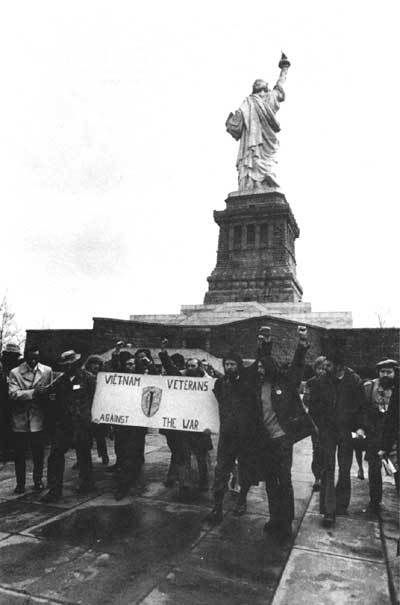
VVAW Anniversary-Dec 26th 1971-Statue of Liberty, Liberation
Six Vietnam veterans founded the VVAW in New York City in 1967 when they marched in a peace demonstration. Organized for returning troops to voice their opposition to the war that was still taking place in Indochina, the VVAW continues to grow, with over 30,000 members, according to the VVAW web Site.
The VVAW {Vietnam Veterans Against the War} focuses mainly on achieving better benefits for all veterans.
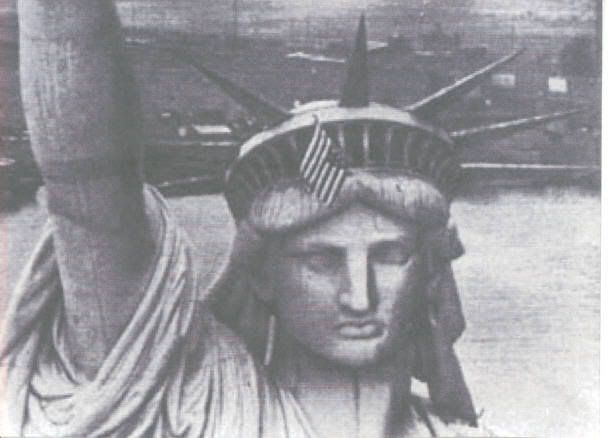
Vietnam Veterans take the Statue of Liberty, December 26th 1971. Two dozen members of Vietnam Veterans Against the War "liberated" the Statue of Liberty with a sit-in to protest resumed U.S. aerial bombings in Vietnam.They flew an inverted U.S. flag from the crown as a signal of distress.
Peace History December 25-31 by Carl Bunin
THE STATUE OF LIBERTY: MONUMENT TO AN EXPANDING SET OF IDEALS
Tim MacCormick of New Jersey and fourteen other members of the Vietnam Veterans Against the War, on the afternoon of December 26, 1971, arrived on Liberty Island by the Circle Line boat along with other tourists. But, when the last return ship to Manhattan sailed that evening, the veterans were not aboard. Instead, just before closing time, they hid among the exhibit partitions, building materials, and storage closets which were lying about the monument's base while work was being finished on the American Museum of Immigration. When NPS personnel made their 7:30 evening check-up of the statue, they found that the veterans had seized control of the landmark and barricaded the three ground floor entrances. The men inside refused to speak to or admit any Park Service people, but on the door they posted a typewritten statement addressed to President Richard M. Nixon:
Each Vietnam veteran who has barricaded himself within this international symbol of liberty has for many years rationalized his attitude to war. . . .We can no longer tolerate the war in Southeast Asia. . . .Mr. Nixon, you set the date [for leaving Vietnam], we'll evacuate. {13}
On December 27, twenty-one National Park police flew to Liberty Island from Washington where they were joined by New York City police and Coast Guardsmen. These security forces stood by while the government attempted to reach a peaceful compromise with the occupiers. They were told that they would be permitted to picket and protest on the island if they would simply vacate the statue, allowing it to reopen to visitors. The veterans rejected the offer, flew the United States flag upside down from the statue's crown, and waited. Law enforcement officers also waited. During that day thousands of disappointed tourists were told at the Battery that they could not go out to the statue. Congresswoman Bella Abzug (Democrat-New York) sent a telephone message of support to the demonstrators.
Members of the Vietnam Veterans Against the War leaving the Statue of Liberty, which they had occupied for two days. The demonstrators emerged in response to a court order, December 28, 1971.
(Source: Photograph Collection of the American Museum of Immigration, Liberty Island, U.S. Department of the Interior, NPS)
Meanwhile, United States Attorney Whitney North Seymour, Jr., went before District Court Judge Lawrence Pierce to request an injunction directing the veterans to open the doors, leave the statue except during regular visiting hours, and permit Park Service personnel and tourists to enter. On the morning of December 28 Judge Pierce issued a temporary restraining order, instructing the protestors to leave the statue "forthwith." Two hours later, after conferring with their lawyers, the veterans removed the barricades from the entrances and emerged with "clenched fists raised." They had cleaned up their debris and caused no significant damage to the property. The monument was reopened to the public, with the first ferry-load of visitors arriving at 2:15 that afternoon.
Tim MacCormick issued a statement to the press explaining why they had picked this particular target:
The reason we chose the Statue of Liberty is that since we were children, the statue has been analogous in our minds with freedom and an America we love.
Then we went to fight a war in the name of freedom. We saw that freedom is a selective expression allowed only to those who are white and maintain the status quo.
Until this symbol again takes on the meaning it was intended to have, we must continue our demonstrations. . . . {14}
The Story of a Vietnam Vet
In the 1970s, when the Department of Veterans’ Affairs cut off about 7.9 million troops’ benefits, the VVAW took over the Statue of Liberty, covering her eyes with protest banners.
“This was the second time that the VVAW had taken over the Statue of Liberty. This would be an 18-hour takeover before the park police finally came and removed us,” Davis recalls. “I was one of those people inside that statue. I was the national coordinator for the (VVAW) at the time.”
There’s a glimmer in Davis’ gray-blue eyes as he tells this story.
“The New York Post carrying a front-page story about how we ruined these poor tourists’ opportunities to see the Statue of Liberty, and we weren’t very sympathetic,” he says.
Davis says that one of the things he hears the most about the VVAW is that it is simply a negative, anti-war organization, but he says that its main goals have been to provide benefits and counseling in order to help veterans.
As Davis trudges through his memories, he recalls that upon coming back, what was harder than seeing his society altered was dealing with how much he had changed.
It’s impossible for anyone who has never been in combat to understand the emotional baggage that soldiers come back with. For those who remain at home, it seems that soldiers are simply away for a while; meanwhile, the soldiers themselves are going through some of the most horrifying and gruesome experiences of their lives, and they are never the same, even when they do come back.
But men like Davis and organizations like the VVAW continue to try making life more livable for returning soldiers.
“We’ve had to do it for ourselves, and once you learn to do it for yourself, you learn to do it for other people,” Davis says. “Modern war brings a lot of horrific images. You don’t ever get over that, you just learn to deal with it.”
Stop Crying: We won our War
Disillusioned with war and plagued by nightmares back in the U.S., Romo and Davis looked to the government for psychological counseling and found nothing.
Next, they turned to the only people they knew they could trust: other war veterans.
“One of the first things we discovered pretty quickly,” said Davis,“was that if we were going to survive, we needed each other to do it.”
But interactions between the Vietnam veterans and veterans’ groups such as the Veterans of Foreign Wars and American Legion were strained, if not belligerent, Davis and Romo recalled.
“There was tremendous hostility from older veterans,” Davis said. “Many of those American Legion types and VFWs said that we were just a bunch of crybabies.”
The VVAW is Formed
But while Davis and Romo were in basic training, six Vietnam vets marched together in a 1967 New York City peace demonstration and founded Vietnam Veterans Against War (VVAW). The VVAW stood in stark contrast to the American Legion and the Veterans of Foreign Wars.
According to Davis, the America Legion represented only a small, selective group of veterans.
Davis describes the Veterans of Foreign Wars as a more egalitarian veterans’ group with the same patriotic function as the American Legion; however, neither focused on benefits. When soldiers from Vietnam began arriving home physically and psychologically damaged, Davis and Romo felt that both groups looked the other way.
From Malaise to Action
On December 26, 1971, sixteen VVAW demonstrators seized the Statue of Liberty in New York City to call attention to what Vietnam vets termed “post-Vietnam stress disorder” as well as the lack of promised programs and benefits.
“In the 1970s, because we were getting nowhere on the issue of stress disorders associated with Vietnam, we declared war on the Veterans Affairs Administration,” Davis said. “Some of us adopted the slogan that we were like ‘no deposit, no return’ bottles … Once the government had emptied us out, they chucked us.”
To assist veterans with post-Vietnam stress, the VVAW gained national recognition in the 1970s for setting up public “rap” therapy groups to help vets deal with painful memories.
We Will not be Ignored
The VVAW took over the Statue of Liberty a second time in 1976, raising even more awareness of veterans’ issues. Since that time, post-Vietnam stress disorder has been formally diagnosed and renamed by the medical community as post-traumatic stress disorder.
Now a group of over 30,000 members, the VVAW works to expose poor and under-funded care in VA hospitals, draft legislation to improve educational job programs and argue for the amnesty of war resisters and vets with questionable dishonorable discharges. During the 1980s, the VVAW publicized the Veterans’ Administration’s attempt to conceal the harmful effects of chemical defoliants like Agent Orange used during Vietnam and the Gulf War.
Passing the Torch
Davis and Romo consider themselves very lucky compared with many of their fellow veterans. Both have held steady jobs for the last 20 years and lead what they describe as normal lives with loving families.
As national coordinators for the VVAW, Davis and Romo both speak regularly at veterans’ events and meeting as well as high schools to instill the wisdom they once so desperately lacked to veterans returning today from Iraq and Afghanistan.
“We’re trying to be like mentors to the new vets,” Romo said. “Basically, we’re doing what other vets didn’t do for us.”
One Vet's Vigil
Christmas reminds Paul Fichter of Miss Liberty takeover 35 years ago
By Tim Blangger Of The Morning Call
December 24, 2006
Referance: Vietnam Veterans Against the War
The Statue of Liberty is among the best known monuments in the world. ... to take-overs by Vietnam veterans and other activists in the 1970s and 1980s. ...PDF
Vietnam Veterans Against the War
Veterans For Peace
Iraq Veterans Against the War
Iraq and Afganistan Veterans of America
Veterans for America
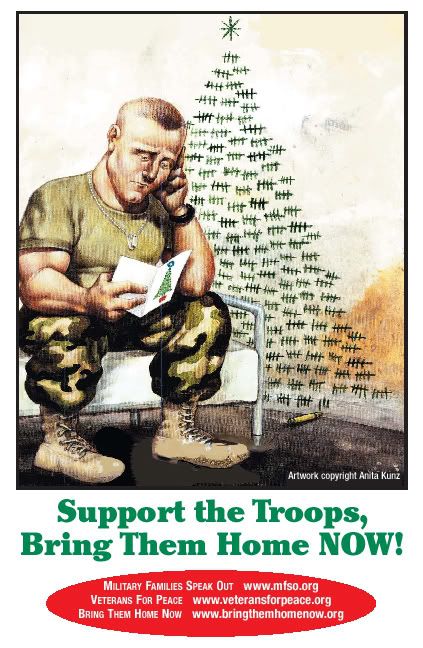
Military Families Speak Out
Veterans For Peace
Bring Them Home NOW
MSN Search Page
Google Search Page
Monday, December 25, 2006
A Holiday Song....
You won't hear at the White House, Halls of Congress, wingnut Homes, rush Radio show, on FOX..............
Posted in reply to below post at another board.
Anybody got the time to put this to a Flash, I may or may not, depending on how the work schedule is for this coming week.
Genocide for the Holidays
Posted in reply to below post at another board.
Anybody got the time to put this to a Flash, I may or may not, depending on how the work schedule is for this coming week.
On This Christmas Day..
War Slogan Memorial

War Is GREAT For Wall Street
Wall St. Bonuses: So Much Money, Too Few Ferraris
$1,000 discount coupons for charter plane service
“It’s your own private jet,” says Ms. Clark with a smile. “You can go wherever you like.”
In recent weeks, immense riches have been rained upon the top bankers and traders. After a year of record profits, investment houses like Goldman Sachs, Lehman Brothers and Morgan Stanley are awarding bonuses as high as $60 million. And a select group of hedge fund managers and private equity executives may be taking home even more.
$250,000 Ferrari 599 GTB Fiorano
Clients trying to spend $20 million on Manhattan properties
Buying $5 million apartments for their children
“We love hedge funds, they are our favorite people” Ms. Kleier said. “They don’t feel like the money is real and they don’t mind spending it — they don’t mind going up by $500,000 or $1 million increments.”
Private planes, or shares of them, are also on the rise
A typical price for a charter flight is $30,000.
The morning Goldman Sachs announced record fourth-quarter and 2006 earnings, Lloyd C. Blankfein, chairman and chief executive, implored his employees — many whom would directly benefit from the bountiful earnings — to avoid excess.
“As stewards of the firm’s reputation, I ask each of you to remember that our actions — inside and outside of the office — reflect on Goldman Sachs. Even a perception of arrogance hurts all of us,” he said in a voice mail sent to the entire firm.
Then, at 7:30 a.m., a black Mercedes pulled up, depositing Mr. Blankfein in front of Ms. Clark. The night before, he had been awarded a $53.4 million bonus.
She offered him a voucher. “How are you?” he said, smiling quickly but refusing the voucher.
“I guess he didn’t want it,” she lamented.
Guess he decided to let it ride for the Needy!
Christmas at War
Happy Christmas - war is over if you want it
WARNING GRAPHIC IMAGES
Happy Christmas (War is over if you want it)
6 U.S. Troops Die in Bloody Iraq Weekend
12,000 Iraqi Policemen Killed Since 2003, Official Says; 6 U.S. Soldiers Killed Over Weekend
How to Get More Boots on the Ground
In Some School Districts, More Teens Opt Out of the Military Recruiting Program
IRAQ:
Refugees Run From Violence to Deprivation
ARBIL, Dec. 24 (IPS) - Khanzad, 26, originally Kurdish, returned to Arbil with her family in mid-2004 after 16 years of living in Baghdad. Like many coming from the violence-stricken city, she has a harrowing story to tell.
Iraqi Hopes Dim Through Worst Year of Occupation
BAGHDAD, Dec 22 (IPS) - Despite promises from Iraqi and U.S. leaders that 2006 would bring improvement, Iraqis have suffered through the worst year in living memory, facing violence, fragmentation and a disintegrated economy.
Pentagon wants $99.7B more for wars
The Pentagon wants the White House to seek an additional $99.7 billion to fund the wars in Iraq and Afghanistan.
Iraqi Christians Celebrate Christmas
BAGHDAD, Iraq (AP) -- Umm Salam draws her curtains across her windows, then settles into an armchair in a living room festooned with colored lights and a portrait of Jesus on the cross. Her Christmas tree glitters in the corner.
UK forces destroy police station in Basra
BASRA, Iraq (Reuters) - British forces killed seven gunmen and flattened the headquarters of the serious crimes unit in southern Basra on Monday after learning prisoners there were about to be executed, the British military said.
And While Wall Street Embrace They're Extreme New Wealth:
Homeless veterans move off the streets just in time for Christmas
SANTA CRUZ — Move over Santa Claus, this year's holiday do-gooders are the homebuilders who have been working double duty to move about a dozen homeless veterans into permanent housing in time for Christmas.
Group looks after homeless veterans
SAN FRANCISCO - A line of homeless war veterans waited along Howard Street on Wednesday afternoon, hoping to get in on an early Christmas present.
Initiative aims to keep returning vets off streets
Mayor and the V.A. team up in effort to provide services, permanent housing for those coming back from overseas
As the city braces for a new crop of military veterans who could struggle with emotional or substance abuse problems upon returning home from Iraq and Afghanistan, Mayor Michael Bloomberg announced yesterday a partnership with the U.S. Department of Veterans Affairs to place homeless veterans into permanent housing and to swiftly serve those at risk of becoming homeless.
Homeless for the holidays
According to statistics provided by the National Coalition for Homeless Veterans, the VA estimates that there are about 200,000 homeless veterans; 45 percent are mentally ill and half suffer from substance abuse; and, Like Brown and Laney, the vast majority are single with little or no family support networks.
MERRY CHRISTMAS
The Failed Policies will Haught Us and the World for Decades!
"A nation of sheep will beget a government of wolves." - Edward R. Murrow
Sunday, December 24, 2006
Happy Christmas??
'The Faith Club'
Religion and True Religious Teachings have nothing to do with what has been going on in this World. Niether does the use of false religious idelogies Justify the destructive actions of us human's on our fellow human. Man uses religion as one of our means to gaining the most nonreligious goals, power, wealth, control. So let the moderate voices of those who carry and give life to man be heard as they struggle to find their own answers and direction and as they find the Common Ground that has always existed.
What is 'The Faith Club'
Three very intelligent young ladies accidently joining the ranks of 'The Focus Groups' finding the knowledge about each others beliefs and ideologies behind those beliefs, finding common ground and knowledge!
These are the voices that should be heard, not only here but in the other regions of the World, especially the Middle East.
There are already many Moderate Voices within those regions but they are kept silent by the radicalism found on all sides.

Ranya Idliby, Suzanne Oliver, Priscilla Warner: "The Faith Club" on the Diane Rehm NPR Show 12-19-06
Three mothers, one a Muslim, one a Jew, and the other a Christian, search for understanding about their religions.
Ranya Idliby, author
Suzanne Oliver, author
Priscilla Warner, author
Real Audio
Windows Media
If you missed this listen to it now, you might just learn something as they did.
Who Are They:

The Faith Club
ABOUT THE BOOK
ABOUT THE AUTHORS
Start A Faith Club
Authors Blog
The Book
The Faith Club: A Muslim, A Christian, A Jew-- Three Women Search for Understanding
There are many other helpful links at their site, once again, The Faith Club
There are a number of people, from all sides, especially in The Middle East, that are talking to each other, interacting with each other, wanting to live peaceful lives. Many of us know many of them as we try and work with them and keep their plight in the forefront, but like them we are now just considered 'Focus Groups' not to be listened to. Trouble is all these 'Focus Groups' have found, Sadly, we're very often Right as to our beliefs and our knowledge, especially when brought together collectively and voiced as one voice. The only way to Strength is in Greater Numbers with a Louder Voice to be heard over the voices of the past Ideologies of Fascism-Refined to modern thought/propaganda, the Extremism of the Radical Right or the Left, the Extremism of the Ideologies of Fundamentalism, the Re-Writing of Religious Ideologies to fit the Minority Groups that Preach Them!
Only by the people coming together can these destructive forces be brought to reign and some sense of stability be brought forward, saving lives and senses!
What is 'The Faith Club'
Three very intelligent young ladies accidently joining the ranks of 'The Focus Groups' finding the knowledge about each others beliefs and ideologies behind those beliefs, finding common ground and knowledge!
These are the voices that should be heard, not only here but in the other regions of the World, especially the Middle East.
There are already many Moderate Voices within those regions but they are kept silent by the radicalism found on all sides.
Ranya Idliby, Suzanne Oliver, Priscilla Warner: "The Faith Club" on the Diane Rehm NPR Show 12-19-06
Three mothers, one a Muslim, one a Jew, and the other a Christian, search for understanding about their religions.
Ranya Idliby, author
Suzanne Oliver, author
Priscilla Warner, author
Real Audio
Windows Media
If you missed this listen to it now, you might just learn something as they did.
Who Are They:
The Faith Club
ABOUT THE BOOK
“Welcome to the Faith Club. We’re three mothers from three faiths—Islam, Christianity, and Judaism—who got together to write a picture book for our children that would highlight the connections between our religions. But no sooner had we started talking about our beliefs and how to explain them to our children than our differences led to misunderstandings. Our project nearly fell apart.”
ABOUT THE AUTHORS
Start A Faith Club
Authors Blog
The Book
The Faith Club: A Muslim, A Christian, A Jew-- Three Women Search for Understanding
There are many other helpful links at their site, once again, The Faith Club
There are a number of people, from all sides, especially in The Middle East, that are talking to each other, interacting with each other, wanting to live peaceful lives. Many of us know many of them as we try and work with them and keep their plight in the forefront, but like them we are now just considered 'Focus Groups' not to be listened to. Trouble is all these 'Focus Groups' have found, Sadly, we're very often Right as to our beliefs and our knowledge, especially when brought together collectively and voiced as one voice. The only way to Strength is in Greater Numbers with a Louder Voice to be heard over the voices of the past Ideologies of Fascism-Refined to modern thought/propaganda, the Extremism of the Radical Right or the Left, the Extremism of the Ideologies of Fundamentalism, the Re-Writing of Religious Ideologies to fit the Minority Groups that Preach Them!
Only by the people coming together can these destructive forces be brought to reign and some sense of stability be brought forward, saving lives and senses!
Subscribe to:
Posts (Atom)