Showing posts with label Statue of Liberty. Show all posts

Saturday, May 30, 2009

"Capture the Flag"

‘Capture the Flag: A Political History of American Patriotism’

The flag is not powerful in spite of its ambiguity; it is powerful because of its ambiguity. It has stood, at different times, for radical democracy, opposition to immigration, the abolition of slavery, unregulated capitalism, segregation, integration, and a hawkish war policy, among many other things.


Read a selection from the introduction of "Capture the Flag: A Political History of American Patriotism" by Woden Teachout

A winter wind swept across New York Harbor on a late after noon the day after Christmas in 1971. Tourists riding the last two ferries from Manhattan to the Statue of Liberty huddled against the bulkheads, sheltering themselves from the gusts. Among the passengers were clusters of long-haired adults in well used army-surplus clothing, looking for all the world like hippies taking in the world-famous landmark. The mission of these fifteen men, however, went far beyond tourism.

Immediately upon docking at the island, the men performed a quick reconnaissance. They wedged open a few doors and then took refuge from sight; some crouched behind the massive supporting columns in the base of the statue. Some found storage closets and tucked themselves away......................Read Rest Here


Description
Americans honor the flag with a fervor seen in few other countries: The Stars and Stripes decorate American homes and businesses; wave over sports events and funerals; and embellish everything from politicians’ lapels to the surface of the moon.

But what does the flag mean? In Capture the Flag, historian Woden Teachout reveals that it has held vastly different meanings over time. It has been claimed by both the right and left; by racists and revolutionaries; by immigrants and nativists. In tracing the political history of the flag from its origins in the American Revolution through the present day, Teachout demonstrates that the shifting symbolism of the flag reveals a broader shift in the definition of American patriotism.

A story of a nation in search of itself, Capture the Flag offers a probing account of the flag that has become America’s icon.


James Patterson, author of "Brown v. Board of Education: A Civil Rights Milestone and Its Troubled Legacy"
“Displaying a fine eye and narrative skill in recounting key episodes—among them the Revolution, nativist riots, the bombardment of Fort Sumter, civil rights activism, and the New York City hard hat riot of 1970—Woden Teachout reminds us of how important the American flag has been as a symbol for a wide variety of patriotic causes.”


Back in December 2006 I posted about this and than again in December 2008 a repost with some added material Distress: December 26th 1971 and December 26th 2008

In that one I started it out with some words and this repost part:

December 26, 1971
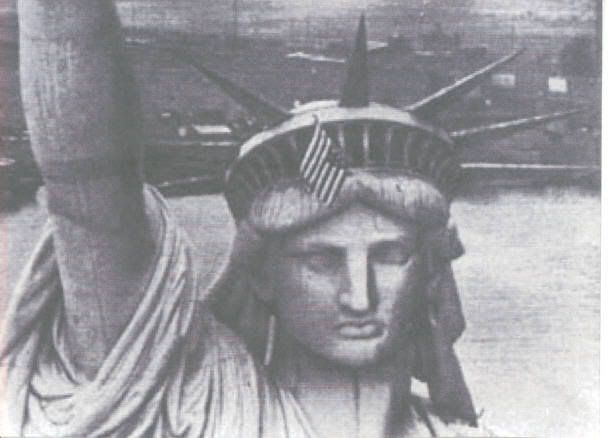
Two dozen members of Vietnam Veterans Against the War "liberated" the Statue of Liberty with a sit-in to protest resumed U.S. aerial bombings in Vietnam. They flew an inverted U.S. flag from the crown as a signal of distress.


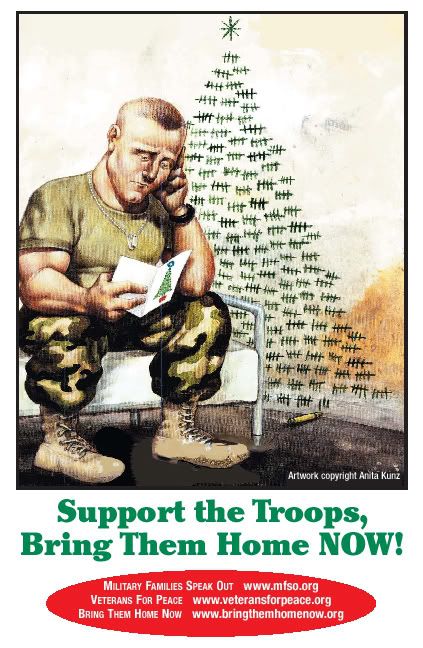
We've now had many years of not one but two Invasions and Occupations better known as Wars of Choice, though soldiers and those occupied are still dying in one it has become a stagnant theater on a hair trigger, the other rapidly ramping up in deaths and destruction, both are and have been recruiting actions for what we now call 'International Terrorism', Criminal Terrorism that will rear it's head, with no boundries, over and over for decades, as the number of those who will carry out these acts have greatly increased due to own terror forced on others!


Below is the '06 post with little change, to remember that shoutout of Distress on it's Anniversary, and as a call for Thought of what we now are facing. Still two occupations of others, this time those serving are doing so over and over and over.............., and to eight years of extremely failed policies and total incompetence as well as multiple corruptions and crimes, in and out of government, but also to the crimes against humanity this country has allowed and seems unwilling to face nor call accountability for!


If you visit this you will find the rest of the 2006 post as well as a few more clips with links and a bigger photo, of the one directly above, of the Distress Flag flying from the crown of the Statue.

While wrapping ourselves in 'Old Glory' we as a Nation are moving further apart under the manipulation of changing political ideologies or the twisting of their meanings, in fear by the voices of the few.

Tuesday, December 26, 2006

VVAW Anniversary-Dec 26th 1971-Statue of Liberty, Liberation

Six Vietnam veterans founded the VVAW in New York City in 1967 when they marched in a peace demonstration. Organized for returning troops to voice their opposition to the war that was still taking place in Indochina, the VVAW continues to grow, with over 30,000 members, according to the VVAW web Site.

The VVAW {Vietnam Veterans Against the War} focuses mainly on achieving better benefits for all veterans.


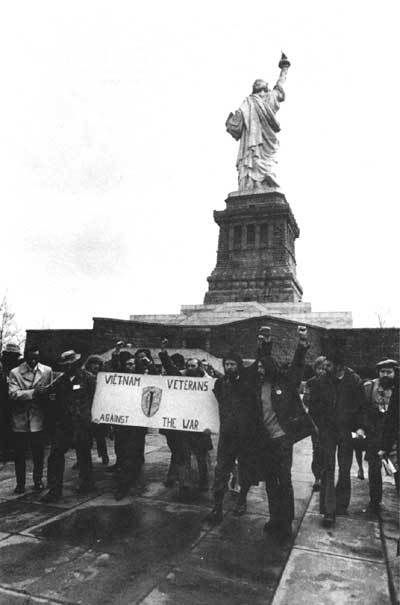
Vietnam Veterans take the Statue of Liberty, December 26th 1971. Two dozen members of Vietnam Veterans Against the War "liberated" the Statue of Liberty with a sit-in to protest resumed U.S. aerial bombings in Vietnam.They flew an inverted U.S. flag from the crown as a signal of distress.
Peace History December 25-31 by Carl Bunin

THE STATUE OF LIBERTY: MONUMENT TO AN EXPANDING SET OF IDEALS

Tim MacCormick of New Jersey and fourteen other members of the Vietnam Veterans Against the War, on the afternoon of December 26, 1971, arrived on Liberty Island by the Circle Line boat along with other tourists. But, when the last return ship to Manhattan sailed that evening, the veterans were not aboard. Instead, just before closing time, they hid among the exhibit partitions, building materials, and storage closets which were lying about the monument's base while work was being finished on the American Museum of Immigration. When NPS personnel made their 7:30 evening check-up of the statue, they found that the veterans had seized control of the landmark and barricaded the three ground floor entrances. The men inside refused to speak to or admit any Park Service people, but on the door they posted a typewritten statement addressed to President Richard M. Nixon:
Each Vietnam veteran who has barricaded himself within this international symbol of liberty has for many years rationalized his attitude to war. . . .We can no longer tolerate the war in Southeast Asia. . . .Mr. Nixon, you set the date [for leaving Vietnam], we'll evacuate. {13}

On December 27, twenty-one National Park police flew to Liberty Island from Washington where they were joined by New York City police and Coast Guardsmen. These security forces stood by while the government attempted to reach a peaceful compromise with the occupiers. They were told that they would be permitted to picket and protest on the island if they would simply vacate the statue, allowing it to reopen to visitors. The veterans rejected the offer, flew the United States flag upside down from the statue's crown, and waited. Law enforcement officers also waited. During that day thousands of disappointed tourists were told at the Battery that they could not go out to the statue. Congresswoman Bella Abzug (Democrat-New York) sent a telephone message of support to the demonstrators.


Members of the Vietnam Veterans Against the War leaving the Statue of Liberty, which they had occupied for two days. The demonstrators emerged in response to a court order, December 28, 1971.
(Source: Photograph Collection of the American Museum of Immigration, Liberty Island, U.S. Department of the Interior, NPS)


Meanwhile, United States Attorney Whitney North Seymour, Jr., went before District Court Judge Lawrence Pierce to request an injunction directing the veterans to open the doors, leave the statue except during regular visiting hours, and permit Park Service personnel and tourists to enter. On the morning of December 28 Judge Pierce issued a temporary restraining order, instructing the protestors to leave the statue "forthwith." Two hours later, after conferring with their lawyers, the veterans removed the barricades from the entrances and emerged with "clenched fists raised." They had cleaned up their debris and caused no significant damage to the property. The monument was reopened to the public, with the first ferry-load of visitors arriving at 2:15 that afternoon.
Tim MacCormick issued a statement to the press explaining why they had picked this particular target:
The reason we chose the Statue of Liberty is that since we were children, the statue has been analogous in our minds with freedom and an America we love.
Then we went to fight a war in the name of freedom. We saw that freedom is a selective expression allowed only to those who are white and maintain the status quo.
Until this symbol again takes on the meaning it was intended to have, we must continue our demonstrations. . . . {14}


The Story of a Vietnam Vet

In the 1970s, when the Department of Veterans’ Affairs cut off about 7.9 million troops’ benefits, the VVAW took over the Statue of Liberty, covering her eyes with protest banners.

“This was the second time that the VVAW had taken over the Statue of Liberty. This would be an 18-hour takeover before the park police finally came and removed us,” Davis recalls. “I was one of those people inside that statue. I was the national coordinator for the (VVAW) at the time.”

There’s a glimmer in Davis’ gray-blue eyes as he tells this story.

“The New York Post carrying a front-page story about how we ruined these poor tourists’ opportunities to see the Statue of Liberty, and we weren’t very sympathetic,” he says.

Davis says that one of the things he hears the most about the VVAW is that it is simply a negative, anti-war organization, but he says that its main goals have been to provide benefits and counseling in order to help veterans.

As Davis trudges through his memories, he recalls that upon coming back, what was harder than seeing his society altered was dealing with how much he had changed.

It’s impossible for anyone who has never been in combat to understand the emotional baggage that soldiers come back with. For those who remain at home, it seems that soldiers are simply away for a while; meanwhile, the soldiers themselves are going through some of the most horrifying and gruesome experiences of their lives, and they are never the same, even when they do come back.

But men like Davis and organizations like the VVAW continue to try making life more livable for returning soldiers.

“We’ve had to do it for ourselves, and once you learn to do it for yourself, you learn to do it for other people,” Davis says. “Modern war brings a lot of horrific images. You don’t ever get over that, you just learn to deal with it.”


Stop Crying: We won our War

Disillusioned with war and plagued by nightmares back in the U.S., Romo and Davis looked to the government for psychological counseling and found nothing.

Next, they turned to the only people they knew they could trust: other war veterans.

“One of the first things we discovered pretty quickly,” said Davis,“was that if we were going to survive, we needed each other to do it.”

But interactions between the Vietnam veterans and veterans’ groups such as the Veterans of Foreign Wars and American Legion were strained, if not belligerent, Davis and Romo recalled.

“There was tremendous hostility from older veterans,” Davis said. “Many of those American Legion types and VFWs said that we were just a bunch of crybabies.”

The VVAW is Formed

But while Davis and Romo were in basic training, six Vietnam vets marched together in a 1967 New York City peace demonstration and founded Vietnam Veterans Against War (VVAW). The VVAW stood in stark contrast to the American Legion and the Veterans of Foreign Wars.

According to Davis, the America Legion represented only a small, selective group of veterans.

Davis describes the Veterans of Foreign Wars as a more egalitarian veterans’ group with the same patriotic function as the American Legion; however, neither focused on benefits. When soldiers from Vietnam began arriving home physically and psychologically damaged, Davis and Romo felt that both groups looked the other way.

From Malaise to Action

On December 26, 1971, sixteen VVAW demonstrators seized the Statue of Liberty in New York City to call attention to what Vietnam vets termed “post-Vietnam stress disorder” as well as the lack of promised programs and benefits.

“In the 1970s, because we were getting nowhere on the issue of stress disorders associated with Vietnam, we declared war on the Veterans Affairs Administration,” Davis said. “Some of us adopted the slogan that we were like ‘no deposit, no return’ bottles … Once the government had emptied us out, they chucked us.”

To assist veterans with post-Vietnam stress, the VVAW gained national recognition in the 1970s for setting up public “rap” therapy groups to help vets deal with painful memories.

We Will not be Ignored

The VVAW took over the Statue of Liberty a second time in 1976, raising even more awareness of veterans’ issues. Since that time, post-Vietnam stress disorder has been formally diagnosed and renamed by the medical community as post-traumatic stress disorder.

Now a group of over 30,000 members, the VVAW works to expose poor and under-funded care in VA hospitals, draft legislation to improve educational job programs and argue for the amnesty of war resisters and vets with questionable dishonorable discharges. During the 1980s, the VVAW publicized the Veterans’ Administration’s attempt to conceal the harmful effects of chemical defoliants like Agent Orange used during Vietnam and the Gulf War.

Passing the Torch

Davis and Romo consider themselves very lucky compared with many of their fellow veterans. Both have held steady jobs for the last 20 years and lead what they describe as normal lives with loving families.
As national coordinators for the VVAW, Davis and Romo both speak regularly at veterans’ events and meeting as well as high schools to instill the wisdom they once so desperately lacked to veterans returning today from Iraq and Afghanistan.

“We’re trying to be like mentors to the new vets,” Romo said. “Basically, we’re doing what other vets didn’t do for us.”


One Vet's Vigil
Christmas reminds Paul Fichter of Miss Liberty takeover 35 years ago
By Tim Blangger Of The Morning Call
December 24, 2006

Referance: Vietnam Veterans Against the War

The Statue of Liberty is among the best known monuments in the world. ... to take-overs by Vietnam veterans and other activists in the 1970s and 1980s. ...PDF


Vietnam Veterans Against the War

Veterans For Peace

Iraq Veterans Against the War

Iraq and Afganistan Veterans of America

Veterans for America


Military Families Speak Out
Veterans For Peace
Bring Them Home NOW

MSN Search Page

Google Search Page