Showing posts with label saddam hussein. Show all posts

Saturday, December 12, 2009

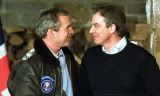
Tony Blair: {UpDated}

Tony, like our own leaders?, have found their excuses and justifications, they sound an awful lot like those of the bin Ladens and Saddam's of this world!

"Iraq War was right even if there were no WMDs"

Tony Blair would have invaded Iraq even if he had known that there were no weapons of mass destruction in the country, he has admitted.

Mr Blair replied: "I would still have thought it right to remove him. I mean, obviously you would have had to use and deploy different arguments about the nature of the threat."

He added: "I can't really think we'd be better off with him and his two sons still in charge but it's incredibly difficult... and that's why I sympathise with the people who were against it for perfectly good reasons and are against it now but, for me, in the end I had to take the decision."

Snip

At a memorial service in St Paul's Cathedral in October to honour British military and civilian personnel who served in Iraq, Mr Blair offered his hand to Peter Brierley, whose son, Lance Corporal Shaun Brierley, was killed in 2003. Mr Brierley told him: "I'm not shaking your hand, you've got blood on it."

Asked if the anger of parents like Mr Brierley was "the cross you will always have to bear", Mr Blair said: "Let's be clear, it's worse for them. They have lost their child and it's very sad. If you have lost your loved one but you think you have lost them in a cause that's not worth it, that makes it worse."

Snip

Elsewhere in the interview, to be broadcast this Sunday, Mr Blair said his faith was central to his life and discussed his conversion to Catholicism in 2007, after leaving office. ..>>>>>


Blair feels all the Deaths, Tens of Thousands of Iraqi, Millions of Iraqi Refugee's, Destroyed Country and Sectarianism, 179 British Soldiers, 4370 and Counting U.S. Soldiers, and Total of 4688 Military Coalition Deaths, as well as the Tens of Thousands of Maimed, Physically and Mentally, Soldiers and Civilians was just Hon-key Dory to take down Saddam and Sons.

As well as being a part of the Human Rights Violations the U.S. was carrying out against not only our Laws but International Laws, of which we and the brits along with other countries wrote and enforced as we also condemn others who break them, on Torture and Rendition's, the Rendition's coming in some cases in the occupied theaters but also many from elsewhere.

UK accused of rendition over men arrested in Iraq

A legal rights charity has accused the government of misleading Parliament over two men arrested by the British military in Iraq.

Reprieve says British forces handed the men to the US military who then took them to Afghanistan in 2004.

It says one of them is a Shia rice trader and not part of a banned group linked to al-Qaeda, as ministers claim...>>>>>


Saddam, a dictator who was once good friends with as well as installed in power, with some western powers being involved! We did more to the Iraqi's then Saddam, and his hencemen, could have dreamed of and in only a few years time, And It Continues with the BlowBack on All, Especially the coming generations, there and World Wide, from not only Iraq but the Whole Region as it's caused major shifts and more hatreds!!

BBC Video cuts of the "Fern Britton Meets... Tony Blair" show to be shown on Sunday 13 December at 10am on BBC One.

Tony Blair on choice to remove Saddam Hussein

And Blair talks about his Faith in his decision making
Tony Blair tells Fern Britton how faith influenced decisions

Where do they miss the obvious, when they speak like this, they sound just like those who we label as our enemies and terrorists!

It's 'righteous' to invade another, using as just one of many excuses of WMD's, weapons of mass destruction, as we use WMD's, weapons of mass destruction, to destroy and kill innocent human beings to silence one!

They and All who hide behind the twisted ideologies they've adapted and call Righteous Religious Beliefs, his Christianity, as they pick pieces of Bible Quotes in their justifications!

Sounds just like, well we know who or whom!!

Mission Accomplished!!

UpDate:

Calls for Prosecution for War Crimes!!

Blair Iraq war admission sparks fresh outrage

Tony Blair's admission that Britain would have backed the Iraq war even if he knew it did not have weapons of mass destruction (WMD) sparked outrage Sunday and calls for his prosecution for war crimes.

The former prime minister, who backed the US-led invasion in 2003, told the BBC it would "still have been right to remove" Iraqi leader Saddam Hussein because of the threat he posed to the region.

Lawyers representing the deposed Iraqi leadership said they would seek to prosecute Blair following his remarks, while one newspaper commentator said it was a "game-changing admission" for the ongoing official inquiry into the war.

Former UN weapons inspector Hans Blix added: "The war was sold on the WMD, and now you feel, or hear that it was only a question of deployment of arguments, as he said, it sounds a bit like a fig leaf that was held up."...>>>>>

Tuesday, December 01, 2009

Iraq War Inquiry, Day Six

As we wait to hear President Obama we already know that he will be increasing military troops in Afghanistan. We now need to hear just what the plan is now going to be, i.e. Exit Strategy, once a mainstay meme of the so called Strong on National Defense GOP. Even a certain State Governor called on the meme: "Victory means exit strategy, and it's important for the president to explain to us what the exit strategy is," - George W. Bush, Texas Gov., 1999

But that was before they increased the hatreds and thus possible enemies towards us a thousand fold and for the coming decades!

I have had on my own mind, especially as I've been catching these reports out of the Inquiry, that we and the U.N. had military troops in Afghanistan already fighting and supposedly searching for the ghost enemy al Qaeda and Especially, "wanted dead or alive", bin Laden, while the drums started beating towards Iraq, We've learned those drum beats started right on 9/11 only hours after the destruction and death, mentioned by Condi Rice and then some three days later by President Bush himself.

This has started raising some more questions we need to hear answers for. We had promised, and not only us but the other western countries, once ridding Afghanistan, and still going after bin Laden, that monies and help would start coming into that country helping them to rebuild, something we promised once before but never kept, after their years of war with the Soviets and the damage we inflicted after 9/11.

One question, with all the beating drums, Who was talking about Afghanistan, securing the country and helping them rebuild? We all know what wasn't done, but was there even any mention of, or were they all so focused on an innocent country Iraq and an old friend Saddam, friend no more, and he knew too much! We may get a chance to find out if there was mention of the Afghan's.

Iraq Inquiry - Day 6

Today, for the first time since the Inquiry began last week, we got a clear sense of a developing narrative... and it is this:

In the run-up to war - those key months between 9/11 (when the Bush Administration's grumblings about Iraq turned to more distinct drum-beats) and the invasion in March 2003 - the UK was determined to lead America down the 'UN route'.

All the witnesses have cited numerous occasions when Tony Blair, with the help of his diplomats and ambassadors, pushed an increasingly disinterested American Administration back to the UN table.

And it worked - to a certain extent.

Snip

They tried, they said, to tell the Americans that there needed to be a plan for what would happen after the invasion. But their message was not getting through.

Sir Peter Ricketts described it like this: "I don't think in the summer of 2002/3... they [the Americans] were putting a great deal of thought into the aftermath period. I think that only really picked up steam in the autumn, when our own discussions with them began to intensify.... it wasn't until the autumn, I think I'm right in saying, that we started to really engage the Americans in a serious discussions of this."

But, by the Autumn, it was the Pentagon, not the State Department taking the lead on all the Iraq planning - invasion and after. And, according to Edward Chaplin - the Pentagon may have been listening, but it was not accepting anyone's advice:

"They [the Pentagon] didn't take many steps to involve their own colleagues in the administration in planning! On the other hand, they were perfectly happy to listen to us..... So it wasn't that they didn't listen, and they were grateful for the papers that we provided and the ideas that we provided, but I don't think the main ideas we were putting forward... got much traction where they counted, which was with the Pentagon."

Snip

The Inquiry is not sitting tomorrow but on Thursday it's the turn of the military chiefs and MoD civil servants. Key questions for them: when were they asked to prepare for military action? What were they asked to prepare for? Was it the right plan? And crucially - to what extent was the UK military participation governed by an inflexible Rumsfeld-driven American military machine?...>>>>>


Maybe on thursday the Military Chiefs and MoD civil servants might be asked, and will answer, what they were talking to their counter parts in the U.S. Military and the Pentagon as they were jumping further into the Iraq invasion plans and searching for the right set of excuses to use, we all know they kept changing so did the U.N.. Was anyone even thinking about bin Laden, al Qaeda, and Especially helping the Afghan People??

Chilcot inquiry: US said Iraqis would welcome invasion

Post-war plans lost due to 'blind spot' in Washington

Legality of war questioned by top cabinet members

British attempts to persuade the US to plan for the consequences of an invasion of Iraq foundered on a "blind spot" in Washington where senior officials thought "everyone would be grateful and there would be dancing in the streets", the Chilcot inquiry into the war was told today.

There was "a touching belief [in Washington] that we shouldn't worry so much about the aftermath because it was all going to be sweetness and light", added Edward Chaplin, head of the Middle East department of the Foreign Office at the time.

It was assumed that all would be well, especially if power was handed to an exiled opposition spokesman such as Ahmed Chalabi. "We said [to the Americans] they had very little credibility in Iraq," Chaplin told the inquiry.

Snip

Senior figures in Whitehall said the failure to draw up a proper plan to protect the civilian population after Iraq was occupied was a prima facie breach of the Geneva conventions.

Today, Chaplin and Sir Peter Ricketts, then political director at the FCO, said they were dismayed by the way the Bush administration failed to take the issue seriously, despite personal appeals from Tony Blair to George Bush...>>>>>


I'll bet that some once friends, probably not real bosom buddies, won't be talking to each other across the pond, as the testimony is really not making the U.S. leadership look very good, not at all, and Rightfully So!

A 'real blind spot' and 'dancing in the streets'!

British attempts to improve postwar planning for Iraq 'ignored by US'
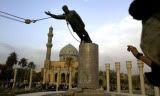
A US marine watches a statue of Saddam Hussein being toppled in Baghdad on 9 April 2003. Photograph: Jerome Delay/AP

Iraq inquiry told by diplomat Edward Chaplin that senior Washington figures had 'real blind spot' and assumed there would be 'dancing in streets' after invasion

British attempts to improve "dire" planning for the aftermath of the Iraq invasion were repeatedly ignored by the US, the inquiry into the war heard today.

Tony Blair raised concerns directly with George Bush amid alarm in Whitehall at the state of the Pentagon's preparations.

But senior figures in Washington had a "real blind spot" and assumed there would be "dancing in streets" when the invasion took place, senior diplomat Edward Chaplin told the inquiry.

"We tried to point out that was extremely optimistic," he said.

Chaplin, who was head of the Middle East section of the Foreign Office at the time of the March 2003 invasion, said there was "a pretty dire state of lack of planning".

There was "a touching belief [in Washington] that we shouldn't worry so much about the aftermath because it was all going to be sweetness and light"....>>>>>


Law lord: Iraq inquiry should issue interim finding that war was illegal
Lord Steyn says it would be a mistake for issue of legality to be kicked into the long grass until after the election

The Iraq inquiry should publish an interim report before the general election declaring the war illegal, a former law lord said today.

Writing in the Financial Times, Lord Steyn said that it would be a mistake for the issue of the legality of the war to be "kicked into the long grass for party political reasons until after the election".

Steyn also criticized the prime minister for not putting a lawyer or a military figure on the inquiry.

Snip

Steyn also said that the inquiry ought to conclude that the war was illegal.

"I would expect the inquiry to conclude – in agreement with Kofi Annan, former secretary-general of the United Nations – that in the absence of a second UN resolution authorizing invasion, it was illegal," he said....>>>>>


And there are some press outlets picking up the inquiry here in the states.

U.S. troops did not expect postwar role, Blair aide says
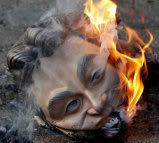
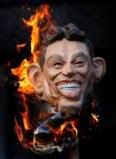
A mask depicting former Prime Minister Tony Blair is burnt by a demonstrator outside the Iraq-war inquiry in London. KIRSTY WIGGLESWORTH / Associated Press

American troops did not expect to play a role in stabilizing Iraq after overthrowing Saddam Hussein, a key adviser to former British Prime Minister Tony Blair said yesterday.

David Manning, who served as a Blair's top foreign-policy aide before being appointed ambassador to Washington in 2003, told a British inquiry into the Iraq war that the American military did not believe peacekeeping was their responsibility.

"The American military thought that they were fighting a war and when the war was over they were expecting to go home," he said.

Snip

(Reviving terrorism allegations against the Hussein regime, the Czech Republic's counterintelligence service said yesterday that in 2000 it disrupted plans by the dictator to attack the offices of U.S.-funded Radio Free Europe/Radio Liberty in Prague to halt its broadcasts into Iraq.)...>>>>>


This short piece, below, by a Mostafa Zein, closes out what has been presented so far very well, with more to come from the inquiry but also the voices of more Mostafa Zein's, I'm sure.

Liars Who Always Speak the Truth

Former British Prime Minister Tony Blair has returned to the media forefront. He is now the best example of the old philosophical debate about lying and the truth. The committee tasked with investigating him will focus on his violation of laws, falsification of the facts, failure to listen to intelligence advisers, and reliance on a silly university thesis to prove the Iraq had weapons of mass destruction.

Snip

At the time (2002), Blair was unwilling to hear any opinion that contradicted his policies. The shouting from President George Bush, appearing like an Old Testament prophet, was louder than anything else, and more important than any legal pretext. This shouting, and Bush’s decision to return Iraq to the Stone Age and his threat to anyone who disobeyed his orders, were the law. Bush found no better partner than the British Prime Minister, who outdid Bush and took it upon himself to gather pretexts and excuses to justify the war. He was smarter than Bush, but was also under his spell. No one else was taken by the charisma of the US president; the British press labeled Blair “Bush’s spoiled puppy.” His decision to take part in the war provoked the public. More than a million demonstrators walked the streets of London to protest his decision. Blair’s foreign minister, Robin Cook, resigned. However, none of this dissuaded him from helping “our grandchildren across the ocean,” as Margaret Thatcher used to say....>>>>>

Monday, November 30, 2009

Iraq War Inquiry, Day Five

Caught the first piece earlier today, lays out similar to what many in our country have been saying for years, especially the recent years, and similar to other countries that are supposed to be leaders on this planet.

Whose foreign policy is it anyway?

Disillusionment with Britain's actions abroad will only intensify without a democratic reassessment of foreign policy principles

Britain is deeply involved in an escalating war in Afghanistan. The legacy of the Iraq war lives on with the drip-drip of revelations emerging from the Chilcot inquiry. This month the first EU foreign secretary was appointed. A general election is months away. These factors constitute a perfect storm that should result in a public debate about the future direction of foreign policy.

Snip

Without accountability we have apathy and frustration. An active, effective and truly participatory debate on the fundamentals of how we conduct politics beyond our national borders will stimulate a broad discussion ranging from issues of national identity to dealing with the foreign policy challenges of the 21st century, from climate change to the threat of sub-state terrorism....>>>>>


Then we get into day five of the inquiry with an aid to Tony Blair testifying, and probably suspected trying to put the best face on the actions taken then and disavowing some previous testimony. But he did make some more interesting points, now on the record, as to what was going on in the minds of our Highest Representative in the Halls of Power the White House!

Blair Aide: 'US Focus On Iraq Days After 9/11'

George Bush raised the issue of Iraq with Tony Blair just three days after the 9/11 attacks, Mr Blair's former foreign policy adviser has said.

He said the former US President told Mr Blair during a phone conversation on September 14, 2001, that there could be a link between Saddam Hussein and al Qaeda...>>>>>


Three days later, Condi brought it up on 9/11, and this would be right around the time all the photo's of all the hijacker's hit the news media and even what planes they were on, and none were Iraqi!

Iraq inquiry: Tony Blair asked for war plans to be prepared in June 2002

Tony Blair asked for war plans to be secretly drawn up in June 2002, almost a year before the invasion of Iraq, his former foreign policy adviser Sir David Manning has told the Iraq Inquiry.

Snip

Sir David said the former prime minister asked defence chiefs to prepare a list of options for military support of a US-led invasion after being told President Bush had set up a “cell” dedicated to planning for a war.

Sir David also disclosed that President Bush and Mr Blair first discussed a possible link between Saddam and the 2001 terrorist attacks on the US just three days after 9/11.

Snip

“At this stage we are aware that military planning is going ahead, that this cell had been set up in Florida, and he was anxious to know what sort of options do we have.

“In July 2002 a letter was sent to the Prime Minister from the defence secretary’s office saying there were three options if we found ourselves involved in military action."...>>>>>


War plans, for an invasion on Iraq? Go figure, and cheney/bush had set up a military cell in the Florida command center to study same back in early 2002. Was this a part of "We're gonna get him dead or alive!" as to bin Laden or Saddam, only the little cowboy would know, or his handlers!

Chilcot inquiry hears Bush began Iraq war drumbeat three days after 9/11

Blair foreign policy adviser David Manning says US president talked up possible links between Saddam and al-Qaida
George Bush tried to make a connection between Iraq and al-Qaida in a conversation with Tony Blair three days after the 9/11 attacks, according to Blair's foreign policy adviser of the time.

Sir David Manning told the official inquiry into the war that Bush, speaking to Blair by phone on 14 September 2001, "said that he thought there might be evidence that there was some connection between Saddam Hussein and Osama bin Laden and al-Qaida."The prime minister's response to this was that the evidence would have to be very compelling indeed to justify taking any action against Iraq," Manning said.

Blair followed up the conversation with a letter stressing the need to focus on the situation in Afghanistan, where the attacks originated.

But by the time Blair went to visit Bush at his ranch in Crawford, Texas, in April 2002 the British were "very conscious that Iraq would be on the agenda", Manning said...>>>>>


Blair adviser: US did not expect to stabilize Iraq

A mask of former British Prime Minister Tony Blair is burnt by a demonstrator outside the Iraq Inquiry in London, Monday, Nov. 30, 2009
American troops did not expect to play a role in stabilizing Iraq after overthrowing Saddam Hussein, a key adviser to former British Prime Minister Tony Blair said Monday.

David Manning, who served as a Blair's top foreign policy aide before being appointed ambassador to Washington in 2003, told a British inquiry into the Iraq war the American military did not believe peacekeeping was their responsibility.

"The American military thought that they were fighting a war and when the war was over they were expecting to go home," he said.

Manning said British troops in Basra talked to local people, but that American troops were not willing to do the same.

Snip

Jeremy Greenstock, the former British ambassador to the United Nations, told the inquiry on Friday that the U.S. was "hell bent" on war with Iraq from the very beginning and undermined efforts by Britain to win international authorization for the invasion. Manning's predecessor as ambassador to the United States, Christopher Meyer, also testified that the U.S. was looking for connections between Iraq and Sept. 11 within hours of the attacks.

Manning echoed Meyer's claim, saying that then-President George W. Bush talked about possible links between Saddam Hussein and al-Qaida, right after the Sept. 11 terror attacks, but that Blair had counseled caution...>>>>>


Well the above is now widely known especially by the tens of tousands of Iraqi dead and their survivors and the millions of refugee's who fled in country or to neighboring countries, not to mention the rest of the World. And here the brains, civilian and military, thought when the War was over Home would be where the soldiers ended up, tell that to those who've done multiple tours since, especially the dead and maimed and their families!

Blair 'sought UN solution' for Iraq

Tony Blair was committed throughout the Iraq crisis to achieving an international solution through the United Nations, his key foreign policy adviser has said.

Giving evidence to the official inquiry into the war, Sir David Manning denied Mr Blair and George Bush had secretly agreed on military action during talks at the President's Texas ranch 11 months before the invasion in March 2003....>>>>>


Iraq inquiry – live, Day Five Minute-by-minute coverage of what could be the most interesting hearing yet

Manning is also interesting because he is the author of at least two leaked memos which are likely to be discussed this afternoon. The first was written in March 2002 and the full text is available on the Downing Street memo website. Manning wrote it after a dinner with Condoleezza Rice, George Bush's national security adviser at the time, and it shows that Blair was declaring his support for regime even before he met Bush at Crawford in April. This is the key quote:

I said that you would not budge in your support for regime change but you had to manage a press, a Parliament and a public opinion that was very different than anything in the States. And you would not budge either in your insistence that, if we pursued regime change, it must be very carefully done and produce the right result.


Manning also wrote a memo, described as the "Manning memo" on Wikipedia, describing the outcome of a meeting that took place between Blair and Bush in the White House on 31 January 2003. The memo shows that Bush was, by then, determined to invade regardless of what happened at the UN and that the two leaders discussed the idea of getting Iraq to shoot down an American spy plane painted in UN colours to create a pretext for war. Philippe Sands, the British law professor who revealed the existence of the memo, said it raised "some fundamental questions of legality, both in terms of domestic law and international law"...>>>>>


Who ya gonna believe, we'll see as this progresses now won't we (?)

Goldsmith was not bullied into declaring Iraq invasion legal, says Blair

Former prime minister denies claims that then-attorney general had been pressured to change stance over legality of conflict


Iraq inquiry team pulls its punches

David Manning, Blair's foreign policy adviser in the run-up to war, was given the safest of rides at the Chilcot inquiry

It is easy to second-guess the Iraq inquiry and, as one watches it unfold live on the internet, to think of all the questions its distinguished members fail to ask. It is also easy to be upset by their manifest unwillingness to use a more forensic style. But today's session of the Chilcot inquiry with Sir David Manning, Tony Blair's foreign policy adviser in the run-up to the war, was truly disappointing.

Snip

Yet he was given the safest and most deferential of rides. Two issues cried out for deeper scrutiny. One was the so-called UN route to tightening the pressure on Saddam Hussein and the consequences of the UN route's failure. Manning laid out the case – which Blair will no doubt repeat when he faces the inquiry next year – that throughout 2002 and early 2003, the PM pressed hard for Bush to take the international coalition approach through the United Nations, while also emphasizing that if it failed, the UK would be at Bush's side in going for war.

Snip

There always was another definition of UN failure, and it was at least as likely as defiance by Saddam. Yet the inquiry members never asked about it. This was the possibility that the UN, for whatever reason, would refuse to authorize war in accordance with Bush's preferred timetable for action.

And this, of course, is what happened. Bush was the man who defied the UN....>>>>>


What will turn up as the days progress? We'll see!

Tuesday, November 24, 2009

British Inquiry Into Iraq War

This is what this Country, the United States, should be doing now or had already done during the previous administration, investigating towards Impeachment and possible Indictments, depending on what evidence of crimes and lies surfaced. Especially if we really are what we like to think and demand others to believe we are and if our Constitution still exist as the leading Representative Democracy on this planet. But leave it up to 'Old Europe', hopefully, to seek answers that should be in the light of day and a part of the physical history added to the already known.

But it's never to late for us to try and minimize the blowback from our extremely destructive policies, or is it!

Rose Gentle seeks truth from Iraq inquiry

The Glasgow mother, whose son Gordon was killed in the Iraq War, has been speaking ahead of the opening of Sir John Chilcot’s inquiry.


{this isn't the video from this report, the news video at link}


The mother of a Glasgow soldier who was killed in Iraq has spoken ahead of the inquiry into why the war began.

Rose Gentle, whose 19-year-old son Gordon died in Basra in 2004, spoke to STV News before travelling down to London for the beginning of the inquiry on Tuesday.

Rose has been an outspoken critic of the Iraq conflict and helped set up the group Military Families against the War...>>>>>


Tuesday 24 November 2009 - Opening of Inquiry

Iraq Inquiry Opens Amid Whitewash Claims

The chairman of an official inquiry into the Iraq war has used his opening remarks to rebuff claims it will be a whitewash and insisted it will be a "fair and frank" investigation.


Sir John Chilcot said he will not will not shy away from being critical in his wide-ranging, televised probe into how the UK came to invade the country in 2003...>>>>>


Chilcot inquiry told UK did not consider Iraq regime change before 9/11

Whitehall refused to engage in talks about toppling Saddam but shared US concerns that containment policy was failing


British officials decided not to get involved in talk about regime change in Iraq in 2001 even though some parts of the new Bush administration began to discuss the possibility two years before the invasion, the opening hearing of the UK inquiry into the war heard today.

But Whitehall was, like Washington, concerned that the policy of containing Saddam Hussein was failing before the September 11 attacks on the US, senior civil servants said....>>>>>


Saddam options 'discussed a year before Iraq war'

British officials privately discussed the prospect of "regime change" in Iraq in late 2001 - more than a year before the invasion - the Iraq War inquiry was told today.

Giving evidence on the first day of public hearings, Sir William Patey, a senior Foreign and Commonwealth Office official, said the idea of ousting Saddam Hussein had been discussed in an internal FCO paper...>>>>>


Iraq Inquiry Digest Everything about the Chilcot Inquiry in one place

Chilcot inquiry into the Iraq war Follow the action as inquiry into one of the most contentious decisions of modern times begins hearing evidence

Iraq Inquiry: Day 1

Well, after just six hours of evidence at an Inquiry that will last over a year and, already, some interesting disclosures.

The top lines are these:

1. There were "drum-beats" of war with Iraq coming from elements of the Bush Administration in early 2001

2. The UK discussed regime change in an internal Foreign Office "options paper" in 2001 but quickly dismissed it as illegal.

The focus of today was context: an effort to establish what the UK's position on Iraq was in 2001 - prior to the 9/11 attacks...>>>>>


"We were conscious that there were other voices in Washington, some of whom were talking about regime change," Ricketts said, citing an article written by National Security Adviser Condoleezza Rice warning that nothing would change in Iraq until Saddam was gone."...>>>>>

Monday, July 13, 2009

July 14, 1958 in Iraq-CIA-U.S.

A group of Iraqi army officers staged a coup in Iraq and overthrew the monarchy of King Faisal II (who had ascended to the throne at age four). The new government, led by Abdul Karim el Qasim, was ousted in 1963 by a coup helped by the CIA and led by the Arab Socialist Ba'ath Party—later dominated by Saddam Hussein.

Saddam Hussein: whom we knew as a brutal street thug, connected to the right family, U.S. ideology of the time, and more importantly, for him, connected to the right people in the U.S. and CIA!

1958: Coup in Iraq sparks jitters in Middle East
A group of Iraqi army officers have staged a coup in Iraq and overthrown the monarchy.

Baghdad Radio announced the Army has liberated the Iraqi people from domination by a corrupt group put in power by "imperialism".

From now on Iraq would be a republic that would "maintain ties with other Arab countries". It said some 12,000 Iraqi troops based in neighboring Jordan have been ordered to return................


And how does a certain, important even then, Iraqi resource play into this coup:

While Iraqis are celebrating on the streets of Baghdad, the news is a cause for concern for western powers worried about their oil interests and instability in the region.


And in those days in the history of the World it was cold, as in cold war mentality.

Officials in Washington fear the Iraqi coup will mean the end of the Baghdad Pact whose members include Turkey, Persia and Pakistan. It was intended to stem the influence of the Soviet Union in the region.

There are fears the Iraq coup will have a domino effect and that the pro-Western oil regimes of Kuwait, Bahrain and the Trucial States may fall to Arab nationalists.


And the CIA, with one Saddam Hussein on the payroll, took it from there:

Iraq's coup leader and prime minister, Abdul Karim el Qasim, was ousted and killed in 1963 in a coup led by the Arab Socialist Ba'ath Party.


And as they say, "The rest is History!", or some would now say, "The history that was is our present!".

Monday, December 01, 2008

1980s: Iraq: Reagan Administration

CNN found that intervention is often weighed against political and economic costs.

Declassified U.S. government documents show that while Saddam Hussein was gassing Iraqi Kurds, the U.S. opposed punishing Iraq with a trade embargo because it was cultivating Iraq as an ally against Iran and as a market for U.S. farm exports.

According to Peter Galbraith, then an idealistic Senate staffer determined to stop Hussein from committing genocide, the Reagan administration "got carried away with their own propaganda. They began to believe that Saddam Hussein could be a reliable partner."

Once-secret Reagan administration documents on Iraq

Saturday, October 25, 2008

Not Surprised: Abu Nidal Apparently Also on U.S. Payroll!!!!

Report: Notorious Palestinian Mercenary Was Hired by U.S. to Find Link Between Saddam and Al-Qaeda

Iraqi papers obtained by The Independent state that Abu Nidal was "colluding" with the U.S.


Iraqi secret police believed that the notorious Palestinian assassin Abu Nidal was working for the Americans as well as Egypt and Kuwait when they interrogated him in Baghdad only months before the Anglo-American invasion of Iraq. Hitherto secret documents which are now in the hands of The Independent -- written by Saddam Hussein's brutal security services for Saddam's eyes only -- state that he had been "colluding" with the Americans and, with the help of the Egyptians and Kuwaitis, was trying to find evidence linking Saddam and al-Qa'ida.

President George Bush was to use claims of a relationship with al-Qa'ida as one of the reasons for his 2003 invasion, along with Iraq's possession of weapons of mass destruction. Western reports were to dismiss Iraq's claim that Abu Nidal committed suicide in August 2002, suggesting that Saddam's own security services murdered him when his presence became an embarrassment for them. The secret papers from Iraq suggest that he did indeed kill himself after confessing to the "treacherous crime of spying against this righteous country".

The final hours of Abu Nidal, the mercenary whose assassinations and murderous attacks in 20 countries over more than a quarter of a century killed or wounded more than 900 civilians, are revealed in the set of intelligence reports drawn up for Saddam's "presidency intelligence office" in September of 2002. The documents state that Egyptian and Kuwaiti intelligence officers had asked Abu Nidal, whose real name was Khalil al-Banna, to spy for them "with the knowledge of their American counterparts". Five days after his death, Iraq's head of intelligence, Taher Jalil Habbush, told a press conference in Baghdad that Abu Nidal had committed suicide after Iraqi agents arrived at the apartment where he was hiding in the city, but the secret reports make it clear that the notorious Palestinian had undergone a long series of interrogations prior to his violent demise. The records of these sessions were never intended to be made public and were written by Iraqi "Special Intelligence Unit M4" for Saddam. While Abu Nidal may have lied to his interrogators -- torture is not mentioned in the reports -- the documents appear to be a frank internal account of what the Iraqis believed his mission in Iraq to be. The papers name a Kuwaiti major, a member of the ruling Kuwaiti al-Sabbah family, as his "handler" and state that he was also tasked to "perform terrorist acts inside and outside Iraq". His presence in the country "would provide the Americans with the pretext that Iraq was harboring terrorist organizations," the reports say.

"Coded messages indicate that the Kuwaitis asked him indirectly to find out whether al-Qa'ida elements were present in Iraq. Our conclusions were confirmed when he [Abu Nidal] started to mitigate his actions with irrational answers when asked about the data against him. He attempted to sidetrack his answers by not being specific and referring to historical matters. It was noted by the investigators that he went from short, ambiguous and unclear replies to generalities … he seemed perturbed … But once he became convinced of the weight of the evidence against him concerning his collusion with both the American and Kuwaiti intelligence apparatuses in co-ordination with Egyptian intelligence, he realized that his treacherous crime of spying against this righteous country had been exposed …"

Abu Nidal was no stranger to Iraq. He had operated from Baghdad, Damascus and the Libyan capital of Tripoli when the regimes wanted to use him as a "gun for hire". It was Iraq which paid him to organize the attack on the Israeli ambassador to London, Shlomo Argov, in 1982, an attempted assassination which prompted Israel to accuse Yasser Arafat of responsibility and to begin its disastrous invasion of Lebanon, and Colonel Muammur Gaddafi later established a close relationship with Abu Nidal. In 1985, his crazed gunmen attacked Israeli-bound passengers at Rome and Vienna airports, killing a total of 18 people. His biographer Patrick Seale, who suggests that for some time Abu Nidal even worked for Israel's Mossad intelligence agency, has written of how, when he feared treachery in his own ranks, a suspected spy would be buried alive, fed through a tube for days and then -- if Abu Nidal's "court" deemed death appropriate -- a bullet would be fired down the tube.

His own interrogation at the hands of Saddam's secret police, will therefore appear equally appropriate punishment for so cruel a man. Among the other crimes of which he was accused in the Iraqi intelligence report was the preparation of 14 booby-trapped suitcase bombs to be used on foreigners -- Swiss and Austrian, according to the intelligence file -- in the northern Kurdish area of Iraq, at the time a U.S.-supported "safe haven", and an attempt to recruit new members for his so-called Fatah Revolutionary Council among Palestinians wounded by the Israelis in the West Bank and Gaza who were recovering in Baghdad hospitals.

There are some oddities in the report and some unanswered questions. It says, for example, that Abu Nidal originally infiltrated Iraq from Iran on a false Yemeni passport years earlier, but that this was facilitated by his own representative in Kuwait, named as Nabil Uthman. Abu Nidal was said to have communicated to Kuwait via coded messages sent through Lebanon and Dubai. The papers give his date of birth as 1939 -- he is believed to have been born in Jaffa in what was then Palestine in 1937 -- and state that he resided in Libya in 1984 but "had no links with the Libyan authorities." He is also stated to have been imprisoned by the Egyptian security services for two months. The man who is said to have provided Abu Nidal with a "safe house" in Baghdad was interrogated in 2002 alongside the Palestinian and is named as Abdulkareem Mohammed Mustapha.

Could Abu Nidal really have entered Iraq from Iran, whose own intelligence services, would surely have questioned him? Could Abu Nidal have lived in secret in the Baathist state of Iraq without Saddam's own mukhabarat finding him? And for how long was he interrogated? The documents give us no answers to these questions.

His end is, however, recorded bleakly. "Upon being asked to accompany those charged with guarding him to a more secure location to continue the interrogation procedures, he requested that he be allowed to change his clothes. On entering his bedroom, he committed suicide. Unsuccessful attempts were made to resuscitate him …" Nothing is known of the fate of Abdulkareem Mustapha, only that he was "submitted to court". But we do know where Abu Nidal now lies.

"The corpse of Sabri al-Banna", the final report concludes, "was buried on 29/8/2002 in al-Karakh's Islamic cemetery [in Baghdad]. Until a final resting place is found, a marker designates the place of burial and it was documented on video as well as on still photographs as 'M7'." No "final resting place" for this savage man appears ever to have been found.

Years of terror: A man as feared as Bin Laden

Abu Nidal, was once as feared as Osama bin Laden. His most notorious attacks included:

*1978 His "Black June" movement blamed for murdering PLO members in London, Paris, Madrid, Brussels, Kuwait and Rome.

*1982 Israeli ambassador to Britain, Shlomo Argov, shot in Mayfair, leaving him permanently paralysed.

*1984 Jordanian airliner attacked by rocket on take-off from Athens. Assassinations included the British cultural attaché in Athens and the British deputy high commissioner in Mumbai.

*1985 Egyptian airliner hijacked - six passengers murdered and 60 killed when the plane is stormed by Egyptian commandos

*1985 Gunmen massacre 18 and wound 120 in attacks on El Al ticket desks at Vienna and Rome airports, bottom left.

*1986 Machine-gun attack kills 22 in a synagogue in Istanbul; at least 20 passengers and crew are killed when Pan Am jet hijacked in Karachi, bottom right.

*1988 Nine killed and 98 wounded when gunmen attack the Greek cruise ship the City of Poros.